Hello and welcome to my ePortfolio for the RESL 1500 Undergraduate Research Certificate! This site showcases my research experiences, skills, and reflections completed as part of the certificate requirements.

INTRODUCTION.
My name is Paul Butland, a fourth-year Communications student at Thompson Rivers University in Kamloops, British Columbia. My academic focus is on research-informed writing, analysis, and design, aiming to understand complex issues and communicate them clearly and responsibly. Throughout my studies, I have honed strong research skills, such as identifying credible sources, evaluating evidence, synthesizing information, and tailoring findings to various academic and practical contexts.
In my coursework, I engaged in structured research projects demanding critical inquiry, ethical sourcing, and clear written arguments. These projects involved formulating research questions, reviewing literature, organizing evidence, and presenting conclusions in a coherent, accessible manner. This academic background has strengthened my ability to conduct independent research, maintaining standards of clarity, accuracy, and integrity.
In practical settings, I have applied these research skills during Co-op work terms and Riipen Level Up projects with community and nonprofit organizations. In these roles, research supported communications planning, grant-related writing, and the development of audience-centered materials. I carried out background research, assessed organizational needs, and translated findings into practical written outputs within professional environments. These experiences required adaptability, teamwork, and understanding research’s role beyond academia.
Together, these academic and applied experiences demonstrate my qualification for the Undergraduate Research Certificate (RESL 1500). They reflect my ability to engage with research processes and communicate findings effectively in real-world situations. Overall, my coursework and practical projects showcase a consistent dedication to using research both as a method of inquiry and as a practical communication tool, aligning with the goals of the Undergraduate Research Certificate.
Outside of university and work, I enjoy writing, music, reading, and exploring the outdoors in Kamloops.
THE STANDARDS.
This research proposal from CMNS 2160 reflects my ability to develop a focused research question within the field of mass communication and popular culture. The proposal and accompanying feedback demonstrate my use of scholarly sources, organization of research, and application of research methods in a structured academic format.
List of Research Courses:
- CMNS 3000 Research Methods Communication – This course provides an overview of the philosophy and practice of communication research. Students are introduced to a range of methods for research in communication and media studies, combining theoretical and epistemological issues with methodological concerns.
- CMNS 4530 Organizational Communications – Students examine the theory and practice of organizational communication through an overview of different models of organizational communication and management, a review of common problems and dilemmas in this field and consideration of the associated strategic practices and associated publications. Students apply both stakeholder engagement theory and models of small-group communication and teamwork to solve strategic communication challenges unique to the internal and external communities of a variety of organization types. In this practice-based course, students complete projects by working in teams which model the dynamics of organizational settings in order to develop strategic, theory- informed solutions to organizational communication challenges.
- CMNS 2160 Mass Communication and the Popular Culture Industry – Students are provided a perspective based on professional practices within the total media environment in which our society operates. This includes an examination of the historical, sociological and economic realities of industries such as television, film, music, advertising, public relations and journalism.
The following assignments from CMNS 4530 include a Stakeholder Analysis and a Strategic Identity Assessment. These projects demonstrate my ability to apply organizational communication theory to practical situations, assess stakeholder relationships, and evaluate how organizations define and communicate their identity. The included work reflects my approach to analyzing communication challenges in a structured and theory-informed manner.
The following assignments from CMNS 3000 include Group Exercise 2 – Observing Others and the Photo Elicitation Final project. These projects demonstrate my application of qualitative research methods, including observation and visual analysis, within communication studies. The work reflects my ability to collect data, interpret findings, and connect observations to relevant research concepts in a structured format.
The following workplan and customer validation report were completed as part of TRU’s Research to Venture program, an applied research initiative that supports students in developing and testing their own business concepts. The program required structured research hours focused on market analysis, stakeholder engagement, and validation of a proposed service model. These documents demonstrate my process of analyzing collected data, assessing feasibility, and drawing evidence-based conclusions to inform business decisions.
- TRU Research to Venture Program – Research Workplan (Nuvio Communications)
- TRU Research to Venture Program – Customer Validation Report (Nuvio Communications)

Research Findings: Oral PowerPoint Presentation for Communications course CMNS 3260. Click the link below to view or download the full presentation for knowledge mobilization.
REFLECTIVE ESSAY.
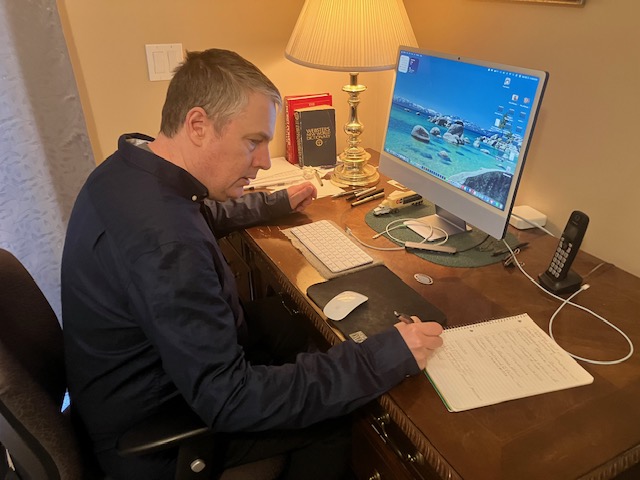
Photo: Working at my desk on research projects for university as part of the Research 2 Venture program
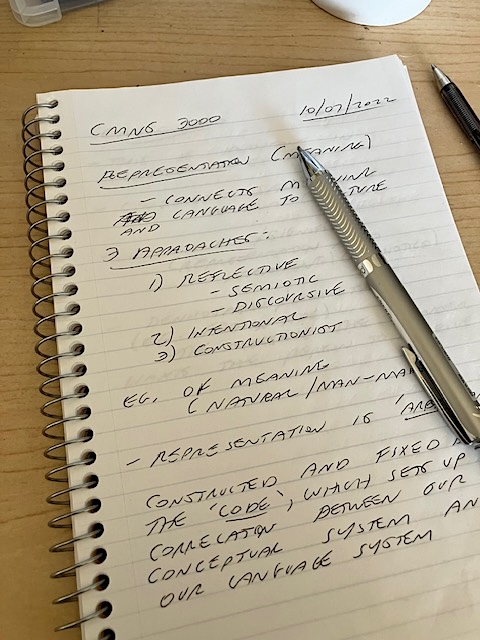
Photo: Paul’s CMNS 3000 Research notes, highlighting key concepts such as representation, meaning, language, culture, and major theoretical approaches.